Smoked Brisket Beef Wellington — The Next-Level BBQ Mashup
Wrap smoky, peppery bark in golden, flaky pastry: a glorious, slightly unhinged centerpiece for confident backyard cooks. Follow my step‑by‑step method and hard-won pro tips to keep the bark crisp, pastry flaky, and brisket juicy — no soggy crust, no dried-out meat.
Why Smoked Brisket Beef Wellington Works (and When to Make It)
Beef Wellington started as a showy way to dress an elegant center‑cut tenderloin — a tender, mild steak swaddled in mushroom duxelles, a salty ham layer and buttery puff pastry. Swapping in smoked brisket sounds outrageous, but it’s smart: brisket brings deep, slow‑cooked beef flavor, a caramelized bark and gelatinous rendered fat that stand up to rich pastry the way a quiet orchestra supports a soloist. Think of it as turning the Wellington concept inside out — same architecture, vastly bigger flavors — and then planning your timing around that heft.
The magic happens in the mouth: smoky, barky notes cutting through a buttery, flaky shell while earthy mushroom duxelles and a salty prosciutto barrier knit everything together. Rendered brisket fat keeps the interior lush, but it’s also the thing that can soggy the pastry if you’re not careful — dry the duxelles well, use prosciutto or a thin crepe as a moisture barrier, and chill the assembled roll so it firms before the oven. Practical touches — a final egg wash for a glossy glaze and a probe thermometer to know when the interior is hot enough — make the difference between a messy experiment and a showstopping centerpiece.
This isn’t a weeknight project, but it’s entirely achievable for an organized pitmaster: smoke a brisket to tenderness a day or two ahead, cool and trim it into a uniform log, prepare a well‑reduced duxelles, layer prosciutto, wrap in puff pastry and finish in a hot oven until golden and heated through. It’s perfect for holidays, milestone birthdays, competition after‑parties or any time you want to flex with a dramatic centerpiece that feeds a crowd. When done right, each slice delivers a contrast of crunchy pastry, silky mushroom, and smoky, melt‑in‑your‑mouth beef — an over‑the‑top mashup that’s worth the planning.
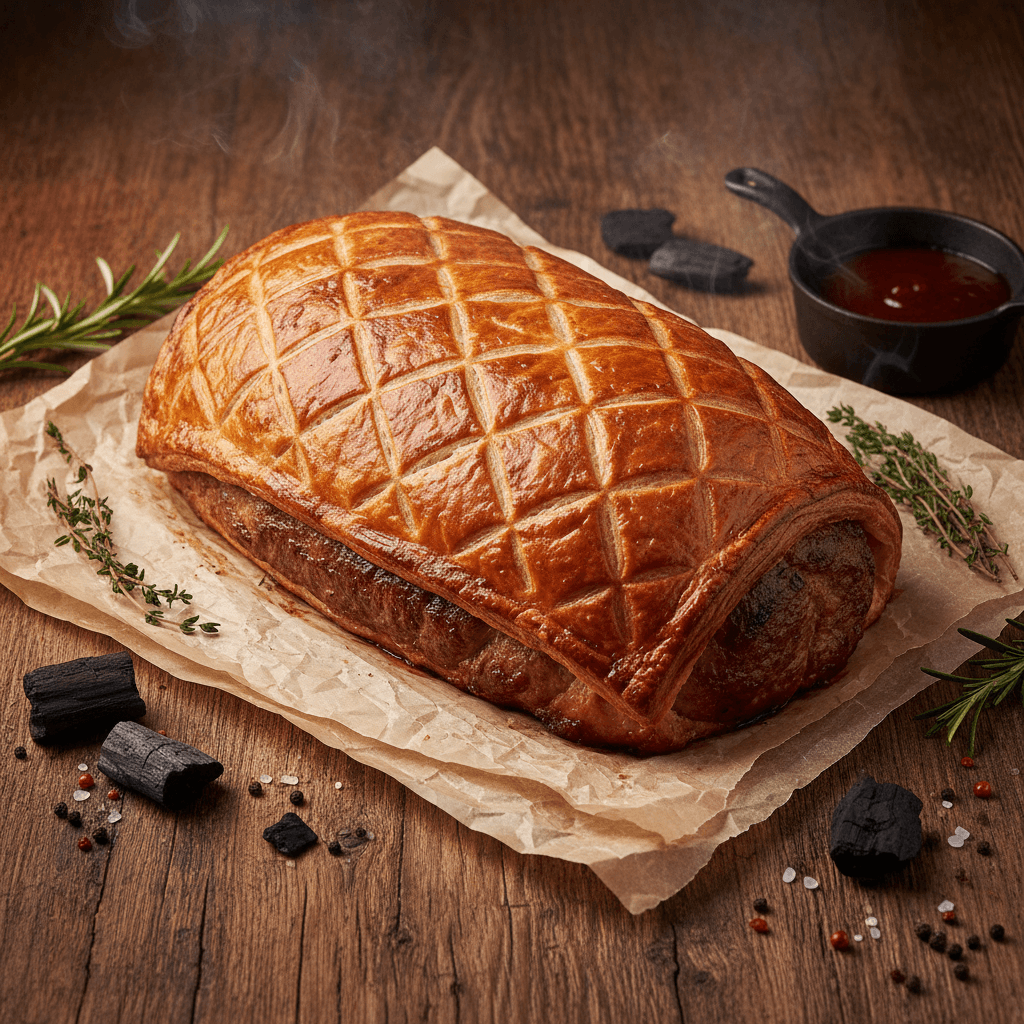
Smoked Brisket Beef Wellington
Tender, deeply smoked brisket wrapped in a savory mushroom duxelles, prosciutto and flaky puff pastry for a show-stopping, over-the-top centerpiece. Combines barbecue smoke with classic Wellington technique for rich, layered flavor and dramatic presentation.
Ingredients
- Whole brisket (trimmed)5–6 lb (2.3–2.7 kg)
- Kosher salt3 tbsp
- Coarse black pepper2 tbsp
- Garlic powder1 tbsp
- Smoked paprika1 tbsp
- Olive oil2 tbsp
- Cremini or mixed mushrooms16 oz (450 g)
- Shallots, finely minced2 large
- Garlic, minced2 cloves
- Fresh thyme leaves1 tbsp
- Unsalted butter2 tbsp
- Dry sherry or Marsala2 tbsp
- Prosciutto slices10–12 slices
- Dijon mustard3 tbsp
- Puff pastry sheets (thawed if frozen)2 sheets (about 17–20 oz total)
- Large egg (for egg wash)1
- Water (for egg wash)1 tsp
- All-purpose flour (for dusting)2 tbsp
- Freshly ground black pepperto taste
- Saltto taste
Steps
- 1
Trim the brisket to an even thickness, leaving about a 1/4-inch fat cap, and pat dry.
- 2
Mix kosher salt, black pepper, garlic powder and smoked paprika and rub all over the brisket with olive oil to coat.
- 3
Refrigerate the seasoned brisket uncovered for at least 2 hours or overnight to dry-brine.
- 4
Preheat your smoker to 225°F (107°C).
- 5
Place the brisket fat-side up in the smoker and smoke at 225°F until the internal temperature reaches 195–203°F (about 6–10 hours), spritzing occasionally if desired.
- 6
Wrap the smoked brisket in foil or butcher paper and let it rest for at least 1 hour to redistribute juices.
- 7
While the brisket rests, finely chop the mushrooms or pulse them in a food processor to a coarse paste.
- 8
Melt butter in a skillet over medium heat, cook the shallots until translucent, add the chopped mushrooms and thyme, and cook, stirring, until all moisture evaporates and the mixture becomes concentrated.
- 9
Deglaze the pan with the sherry, reduce until nearly dry, then remove the duxelles from heat and cool to room temperature.
- 10
Slice the rested brisket thinly against the grain into roughly 1/8–1/4-inch slices.
- 11
Lay a large sheet of plastic wrap on the counter and overlap prosciutto slices into a rectangle slightly wider than your brisket log.
- 12
Spread a thin, even layer of cooled duxelles over the prosciutto, leaving a 1-inch border around the edges.
- 13
Lightly brush Dijon mustard onto each slice of brisket and arrange the slices in overlapping layers on top of the duxelles to form a compact log.
- 14
Use the plastic wrap to roll the prosciutto and brisket into a tight cylinder, twist the ends to secure, and chill until firm, at least 30 minutes.
- 15
Preheat your oven to 400°F (205°C).
- 16
On a lightly floured surface, roll out the puff pastry into a rectangle large enough to fully encase the chilled brisket log.
- 17
Beat the egg with the water and brush a thin layer of egg wash along the pastry edges.
- 18
Unwrap the chilled brisket log, place it seam-side down on the pastry leaving a one-inch border, and trim any excess pastry.
- 19
Fold the pastry over the log, pinch and seal all seams, tuck the ends neatly, and brush the entire surface with egg wash.
- 20
Chill the wrapped Wellington for at least 30 minutes to firm the pastry and seams.
- 21
Optionally score the top of the pastry for decoration and apply a second coat of egg wash.
- 22
Bake the Wellington at 400°F for 25–35 minutes until the pastry is deep golden. Use an instant-read or probe thermometer inserted into the center of the meat log to check internal temperature: if using pre-smoked (fully cooked) brisket, pull when the center reaches 135–140°F; if enclosing raw beef, pull when the meat's internal temperature reaches 125–130°F for medium-rare (it will rise a few degrees while resting).
- 23
Remove the Wellington from the oven and let it rest for 10–15 minutes to allow juices to settle.
- 24
Slice the Wellington into 1-inch portions with a sharp serrated knife and serve immediately.
Tender, deeply smoked brisket wrapped in a savory mushroom duxelles, prosciutto and flaky puff pastry for a show-stopping, over-the-top centerpiece. Combines barbecue smoke with classic Wellington technique for rich, layered flavor and dramatic presentation.
Ingredients
- Whole brisket (trimmed)5–6 lb (2.3–2.7 kg)
- Kosher salt3 tbsp
- Coarse black pepper2 tbsp
- Garlic powder1 tbsp
- Smoked paprika1 tbsp
- Olive oil2 tbsp
- Cremini or mixed mushrooms16 oz (450 g)
- Shallots, finely minced2 large
- Garlic, minced2 cloves
- Fresh thyme leaves1 tbsp
- Unsalted butter2 tbsp
- Dry sherry or Marsala2 tbsp
- Prosciutto slices10–12 slices
- Dijon mustard3 tbsp
- Puff pastry sheets (thawed if frozen)2 sheets (about 17–20 oz total)
- Large egg (for egg wash)1
- Water (for egg wash)1 tsp
- All-purpose flour (for dusting)2 tbsp
- Freshly ground black pepperto taste
- Saltto taste
Steps
- 1
Trim the brisket to an even thickness, leaving about a 1/4-inch fat cap, and pat dry.
- 2
Mix kosher salt, black pepper, garlic powder and smoked paprika and rub all over the brisket with olive oil to coat.
- 3
Refrigerate the seasoned brisket uncovered for at least 2 hours or overnight to dry-brine.
- 4
Preheat your smoker to 225°F (107°C).
- 5
Place the brisket fat-side up in the smoker and smoke at 225°F until the internal temperature reaches 195–203°F (about 6–10 hours), spritzing occasionally if desired.
- 6
Wrap the smoked brisket in foil or butcher paper and let it rest for at least 1 hour to redistribute juices.
- 7
While the brisket rests, finely chop the mushrooms or pulse them in a food processor to a coarse paste.
- 8
Melt butter in a skillet over medium heat, cook the shallots until translucent, add the chopped mushrooms and thyme, and cook, stirring, until all moisture evaporates and the mixture becomes concentrated.
- 9
Deglaze the pan with the sherry, reduce until nearly dry, then remove the duxelles from heat and cool to room temperature.
- 10
Slice the rested brisket thinly against the grain into roughly 1/8–1/4-inch slices.
- 11
Lay a large sheet of plastic wrap on the counter and overlap prosciutto slices into a rectangle slightly wider than your brisket log.
- 12
Spread a thin, even layer of cooled duxelles over the prosciutto, leaving a 1-inch border around the edges.
- 13
Lightly brush Dijon mustard onto each slice of brisket and arrange the slices in overlapping layers on top of the duxelles to form a compact log.
- 14
Use the plastic wrap to roll the prosciutto and brisket into a tight cylinder, twist the ends to secure, and chill until firm, at least 30 minutes.
- 15
Preheat your oven to 400°F (205°C).
- 16
On a lightly floured surface, roll out the puff pastry into a rectangle large enough to fully encase the chilled brisket log.
- 17
Beat the egg with the water and brush a thin layer of egg wash along the pastry edges.
- 18
Unwrap the chilled brisket log, place it seam-side down on the pastry leaving a one-inch border, and trim any excess pastry.
- 19
Fold the pastry over the log, pinch and seal all seams, tuck the ends neatly, and brush the entire surface with egg wash.
- 20
Chill the wrapped Wellington for at least 30 minutes to firm the pastry and seams.
- 21
Optionally score the top of the pastry for decoration and apply a second coat of egg wash.
- 22
Bake the Wellington at 400°F for 25–35 minutes until the pastry is deep golden. Use an instant-read or probe thermometer inserted into the center of the meat log to check internal temperature: if using pre-smoked (fully cooked) brisket, pull when the center reaches 135–140°F; if enclosing raw beef, pull when the meat's internal temperature reaches 125–130°F for medium-rare (it will rise a few degrees while resting).
- 23
Remove the Wellington from the oven and let it rest for 10–15 minutes to allow juices to settle.
- 24
Slice the Wellington into 1-inch portions with a sharp serrated knife and serve immediately.
Carryover & Chill
This recipe assumes you smoke the brisket to finished tenderness, then assemble and reheat slices in the oven; the step‑by‑step sequence follows that approach. This recipe follows method A: smoke the brisket to finished tenderness (about 195–203°F) as directed, then rest and chill before slicing — the oven step here is only to warm assembled slices, not to finish the brisket’s internal cook. If you choose to finish the meat from a less‑cooked state instead (method B), pull the brisket slightly under your final target and use the oven to bring it to temperature. Never wrap steaming‑hot meat in pastry: cool and chill slices, use a moisture barrier (prosciutto, crepes, etc.) and fully reduced duxelles to prevent soggy bottoms, and always use a thermometer plus color‑coded boards/plates to prevent cross‑contamination.
Step-by-Step Build: From Smoker to Showpiece
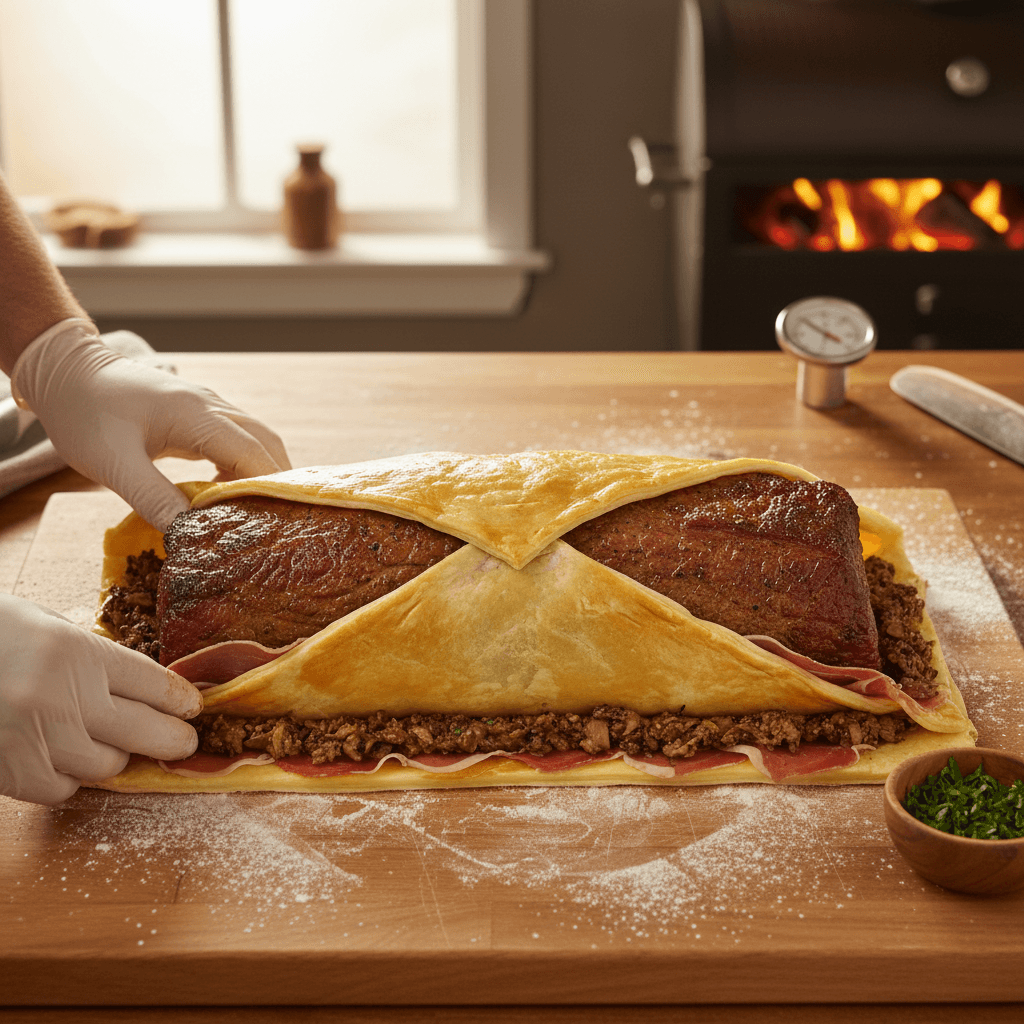
Start with a brisket that’s had time to rest: pull it off the smoker a few degrees shy of your final target, loosely tent it, and trim it into an even log so the final Wellington will bake uniformly. The goal is a slightly under-temp interior so the oven finish won’t overcook the meat and the glorious bark remains intact. Protect that bark by handling the brisket gently — don’t scrape it or rub it hard during the next steps — and slice or press only where needed to create a neat cylinder.
Lay a large sheet of plastic wrap on your work surface and arrange overlapping slices of prosciutto or another cured charcuterie to form a continuous blanket; this is the barrier that preserves texture and concentrates flavor without turning the pastry soggy. Spoon cooled mushroom duxelles into the center of the charcuterie blanket and spread it in an even, thin layer — cooled duxelles won’t melt the meat fats or slide off, and a thin layer keeps the bite balanced so the pastry can crisp. Set the brisket on top and use the plastic wrap to roll everything into a tight, compact log, pulling the wrap taut as you go; twist the ends and chill for at least 30–60 minutes (or pop it briefly into the freezer for 10–20 minutes) until firm. A firm roll gives you clean edges and helps the pastry lay smooth without tearing.When it’s time for the pastry, roll out cold puff pastry to fit the log with a little overlap. Unwrap the chilled meat roll and place it seam-side down on the pastry, then brush the pastry edge with beaten egg and fold snugly around the brisket, sealing the seam on the underside. Keep joins and seams underneath so the top can display simple decorative scoring — a few shallow diagonal lines or a lattice pattern — and finish with a glossy egg wash for that deep golden sheen. Chill again for 30–45 minutes after wrapping: a well-chilled assembly helps the butter layers in the pastry stay distinct, encourages even puff, and dramatically reduces blowouts. Final baking tip: put the Wellington straight into a preheated oven from the fridge, monitor color, and tent loosely if the pastry is browning before the internal temperature reaches your finish target.
Frequently Asked Questions
Serving, Slicing, and Owning the Drama
Let the Wellington rest. If you plan to serve hot and will slice shortly after baking, plan on about 10–15 minutes so the juices settle but the center stays warm. For larger joints or if you prefer firmer pastry and cleaner, cooler slices, rest 20–30 minutes (up to 45 minutes for very large roasts). The trade-off is simple: a longer rest gives firmer pastry and more-settled juices but a cooler center. Tent loosely with foil so the crust keeps its sheen without steaming; you want those juices to settle, not run, so each slice stays glossy and intact instead of turning into a delicious puddle.
When it’s time to slice, use a long, very sharp carving or slicing knife and make confident, single strokes. A gentle forward push with a steady pull back works better than sawing—press just enough to cut through the dark, smoky bark and golden, flaky pastry without shredding the meat. Aim for ¾–1 inch slices for the best ratio of beef to pastry; wipe the blade between cuts with a clean towel or run it briefly under hot water and dry it to keep edges clean and the cross-section picture-perfect.
Keep the accompaniments simple so they lift rather than compete with the richness: a warm, reduced beef jus or quick red-wine pan sauce, a bright horseradish crème fraîche (mix crème fraîche or sour cream with prepared horseradish, lemon, and salt), and perhaps a small pot of grainy mustard. Sides that cut through fat—charred broccolini, lemony arugula salad, roasted baby carrots, or buttered new potatoes—are perfect partners. Serve the Wellington on a warm platter and consider carving at the table for maximum spectacle.
Most of all, have fun with it. This is a slightly unhinged, over-the-top mashup—own the drama and enjoy the reactions. Let the flavors do the talking, bring plenty of napkins, and don’t stress if a slice looks a little rustic; the combination of smoky bark, tender brisket and buttery pastry is what people will remember. Toast the experiment and repeat it—once you’ve pulled off one, you’ll already be dreaming up the next playful twist.