Trash Can Turkey: The Campfire Thanksgiving Showstopper
Leave the oven behind and let the campsite do the work: a whole turkey quietly roasting under a metal can while coals glow and family chatter drifts through the pines. Picture golden, smoked skin, the sweet scent of charcoal and herbs, and meat so juicy it practically falls off the bone—achieved without fancy gear, long lectures, or kitchen stress. Simple, reliable, and endlessly story-worthy, this method turns a camping Thanksgiving into a relaxed centerpiece everyone will remember.
Why Trash Can Turkey Belongs at Your Next Camping Thanksgiving
Trash can turkey is exactly what it sounds like: a whole bird set upright and cooked beneath an inverted, food-safe metal can while a ring or bed of hot charcoal surrounds the base. Think of a makeshift, portable oven built from steel and coals — the can traps and reflects heat down and around the turkey, while the bird's vertical position lets hot air circulate freely. For safety and flavor, use a clean, uncoated steel can or a purpose-made drum and avoid any containers with paints or galvanization that could contaminate the meat.
The science is pleasantly simple: radiant heat from the glowing coals heats the can and the space underneath it, and the closed space creates convection that mimics an oven. That combination produces even temperatures all around the bird — the top of the can acts like a lid, so hot air circulates and keeps the turkey cooking uniformly instead of just from the bottom. Because the bird sits upright, juices run downward and baste the meat as it roasts, which helps deliver surprisingly juicy breast meat while the exposed skin crisps into a golden, crackling crust.
For campers this method is magic: you don’t need a full smoker or an oven, and it requires far less babysitting than spit-roasting or constant tending of an open fire. Once the coals are going and the can is in place, you can monitor with a simple probe thermometer and enjoy the campsite instead of hovering. The flavor is honest and delicious — a light charcoal-smoky note, deeply roasted aromatics, succulent meat and crisp skin — without hours of smoke management. Be realistic: it’s a rustic, showy technique, not a boutique kitchen process, but with basic temperature checks (the USDA minimum safe internal temperature for all poultry is 165°F; some cooks prefer cooking the thigh to 175–180°F for texture and to make the dark meat easier to pull apart, but reaching 165°F anywhere in the bird is the safety baseline. Insert the probe into the thickest part of the breast without touching bone and into the thickest part of the thigh to check temperatures. If the thigh rises into the 175–180°F range the meat is still safe and often more tender; no additional holding time is required for safety, though letting the turkey rest 15–30 minutes before carving helps redistribute juices.) and a couple hours of cooking you can turn out a centerpiece that rivals birds from expensive ovens and smokers.
Food‑Safe Container
Do not use painted, plastic‑lined, or galvanized cans for cooking — avoid attempting to remove coatings or galvanization yourself. Choose an uncoated steel drum, stainless container, or a purpose‑made food‑grade vessel. If you’re unsure whether a can is safe, discard it or use a certified food‑grade alternative. Thoroughly degrease and rinse, then either line the interior with heavy‑duty aluminum foil or set the bird in a dedicated food‑grade roasting pan to avoid chemical contamination.
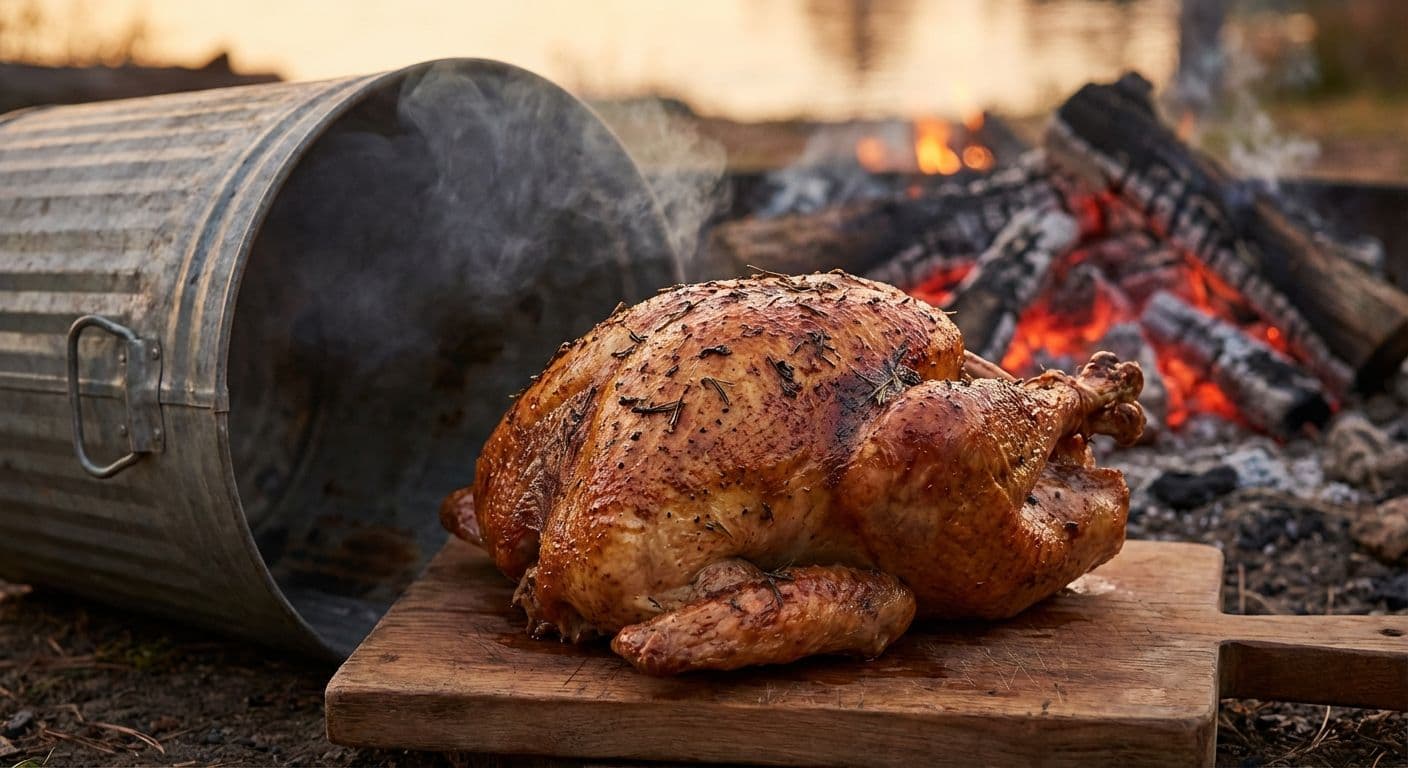
Trash-Can Camping Turkey
A simple, show-stopping whole turkey cooked upright inside a foil-lined steel trash can over charcoal — moist, crispy, and surprisingly easy for a campsite Thanksgiving. Active prep is about 30–45 minutes; total time about 3.5 hours (including ~2–2.5 hours cooking and a 20–30 minute rest).
Ingredients
- Unlined steel trash can (galvanization removed and cleaned)1
- Sturdy stake or wooden dowel wrapped in heavy-duty foil1
- Heavy-duty aluminum foil1 roll
- Shovel or fireproof digging tool1
- Charcoal (lump or briquettes)10–20 lb (start with ~10–12 lb on top; reserve remainder)
- Chimney starter or lighter1
- Long tongs1 pair
- Meat thermometer (instant-read or probe; Bluetooth optional)1
- Heat-resistant gloves1 pair
- Whole turkey (12–16 lb)1
- Oil or melted butter1/4–1/2 cup
- Kosher salt2 tablespoons (or to taste)
- Black pepper1 tablespoon (or to taste)
- Poultry herbs (sage, thyme, rosemary)2–4 tablespoons total, optional
- Optional aromatics (1 onion, 4 garlic cloves, 1 lemon)As desired
Steps
- 1
Confirm the steel trash can is unlined and has had any galvanization burned off and cleaned several days before cooking.
- 2
Wrap a sturdy stake or wooden dowel completely in heavy-duty foil and set aside.
- 3
Pat the turkey dry inside and out with paper towels.
- 4
Rub the turkey with 1/4–1/2 cup oil or melted butter, working some under the breast skin where possible.
- 5
Season the turkey generously with salt, pepper, and poultry herbs and place optional aromatics into the cavity.
- 6
Insert the foil-wrapped stake through the turkey cavity from tail to neck and drive or seat the stake so the bird stands upright securely.
- 7
Line the interior of the trash can with heavy-duty foil, leaving extra foil over the rim to catch drips and protect the can.
- 8
Invert the foil-lined can over the turkey and work the rim down until the turkey is centered and the can sits stably.
- 9
Light charcoal in a chimney starter and using long tongs and heat-resistant gloves place an even 2–3 inch ring of lit coals around the top rim of the can and a small pile in the center.
- 10
Top the rim with additional lit charcoal to form a contiguous heat ring and reserve extra charcoal for touch-ups if needed.
- 11
Insert a meat thermometer probe into the thickest part of the breast and another into the thigh if available, routing any wires out before sealing.
- 12
Allow the turkey to cook mostly undisturbed for about 90–120 minutes while monitoring internal temperature progress.
- 13
Aim for internal temperatures of 165°F in the breast and 175°F in the thigh and expect the can interior to run roughly 325–380°F.
- 14
When target temperatures are reached, be aware the can (with hot coals and ash) will be extremely hot and heavy. Have at least two people lift: one person lifts the can straight up while a second steadies the bird; both should wear long heat-resistant gloves and/or use proper lifting handles. Use sturdy tongs to steady the turkey and move slowly to a stable surface before removing the can and taking the bird off the stake.
- 15
Tent the turkey loosely with foil and rest for 20–30 minutes before carving.
- 16
Carve the turkey and serve warm.
A simple, show-stopping whole turkey cooked upright inside a foil-lined steel trash can over charcoal — moist, crispy, and surprisingly easy for a campsite Thanksgiving. Active prep is about 30–45 minutes; total time about 3.5 hours (including ~2–2.5 hours cooking and a 20–30 minute rest).
Ingredients
- Unlined steel trash can (galvanization removed and cleaned)1
- Sturdy stake or wooden dowel wrapped in heavy-duty foil1
- Heavy-duty aluminum foil1 roll
- Shovel or fireproof digging tool1
- Charcoal (lump or briquettes)10–20 lb (start with ~10–12 lb on top; reserve remainder)
- Chimney starter or lighter1
- Long tongs1 pair
- Meat thermometer (instant-read or probe; Bluetooth optional)1
- Heat-resistant gloves1 pair
- Whole turkey (12–16 lb)1
- Oil or melted butter1/4–1/2 cup
- Kosher salt2 tablespoons (or to taste)
- Black pepper1 tablespoon (or to taste)
- Poultry herbs (sage, thyme, rosemary)2–4 tablespoons total, optional
- Optional aromatics (1 onion, 4 garlic cloves, 1 lemon)As desired
Steps
- 1
Confirm the steel trash can is unlined and has had any galvanization burned off and cleaned several days before cooking.
- 2
Wrap a sturdy stake or wooden dowel completely in heavy-duty foil and set aside.
- 3
Pat the turkey dry inside and out with paper towels.
- 4
Rub the turkey with 1/4–1/2 cup oil or melted butter, working some under the breast skin where possible.
- 5
Season the turkey generously with salt, pepper, and poultry herbs and place optional aromatics into the cavity.
- 6
Insert the foil-wrapped stake through the turkey cavity from tail to neck and drive or seat the stake so the bird stands upright securely.
- 7
Line the interior of the trash can with heavy-duty foil, leaving extra foil over the rim to catch drips and protect the can.
- 8
Invert the foil-lined can over the turkey and work the rim down until the turkey is centered and the can sits stably.
- 9
Light charcoal in a chimney starter and using long tongs and heat-resistant gloves place an even 2–3 inch ring of lit coals around the top rim of the can and a small pile in the center.
- 10
Top the rim with additional lit charcoal to form a contiguous heat ring and reserve extra charcoal for touch-ups if needed.
- 11
Insert a meat thermometer probe into the thickest part of the breast and another into the thigh if available, routing any wires out before sealing.
- 12
Allow the turkey to cook mostly undisturbed for about 90–120 minutes while monitoring internal temperature progress.
- 13
Aim for internal temperatures of 165°F in the breast and 175°F in the thigh and expect the can interior to run roughly 325–380°F.
- 14
When target temperatures are reached, be aware the can (with hot coals and ash) will be extremely hot and heavy. Have at least two people lift: one person lifts the can straight up while a second steadies the bird; both should wear long heat-resistant gloves and/or use proper lifting handles. Use sturdy tongs to steady the turkey and move slowly to a stable surface before removing the can and taking the bird off the stake.
- 15
Tent the turkey loosely with foil and rest for 20–30 minutes before carving.
- 16
Carve the turkey and serve warm.
"Nothing says ‘I nailed Thanksgiving’ like hauling a golden, juicy turkey out of a trash can over a campfire — one big bag of charcoal, a foil-wrapped spit, a couple hours, and the family is speechless. Low-tech, zero stress, and somehow fancier than half the ovens I’ve seen."
Pro Tips, Variations, and Camp Cook Hacks
Once you’ve proven the method works, small changes make a big difference in fuel use and stress level. You don’t need an entire 20‑lb bag to get a deep, even roast — many campers reliably run a trash‑can turkey on roughly 8–12 pounds of charcoal or lump, banked around the base and piled thinly at the bottom so heat circulates instead of burning straight up. Save the rest for topping up; lighting a chimney full of hot coals and adding a few every hour is far more efficient than trying to feed one massive pyre. That said, some cooks deliberately over‑fuel — loading more coals up front — because it buys time and reduces babysitting when you’re at a busy campsite. If you choose that route, plan for stronger ventilation and watch the ambient temp so you don’t scorch the skin.
Temperature monitoring and stability are the real secret weapons. Use a dual‑probe thermometer — one probe in the thickest part of the breast or thigh and one clipped to the can interior — so you can follow both internal meat temp and ambient cooking temp without opening the lid. Bluetooth probes are a game changer at camp: they let you wander, sip cider, and only return when an alarm tells you the bird is near 165°F (the safe target) and the can is holding in the 300–350°F range for a steady roast. For stability, stake the turkey vertically: slip a stout stainless rod or rebar through the cavity and anchor it into a small block or the bottom of the can so the bird can’t topple. Do this before you heat the coals, wear heat‑resistant gloves while adjusting, and test the set‑up with a cold run to make sure the bird clears the coals and sits centered.
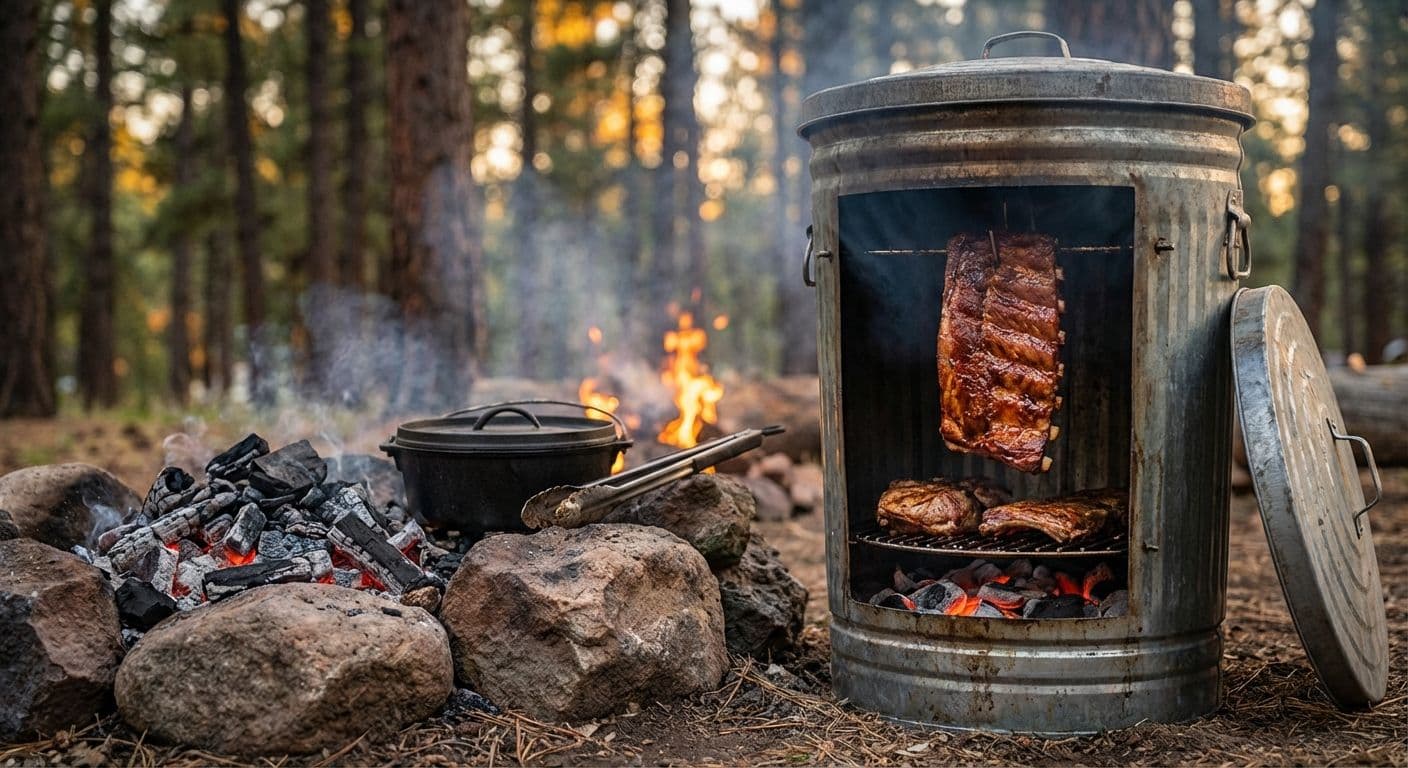
Once you’re comfortable, get creative: drill a few small holes near the lid rim and hang racks or S‑hooks to suspend slabs of ribs, small chickens, or sausages so they roast in the rising heat while the turkey cooks below, producing wonderful layered aromas. A converted beer keg or 55‑gallon drum is an excellent upgrade — better heat retention, easier hanging points and space for two smaller birds on racks. For larger groups, scale horizontally: run multiple cans side‑by‑side, or pair a single trash‑can turkey with a glazed ham in a second vessel; stagger start times so everything finishes hot together. Final tip — always strip paint or coatings and season the metal well before cooking, keep a pair of long tongs and a fire extinguisher nearby, and let the can rest while the turkey rests so juices redistribute into a glossy, succulent finish.